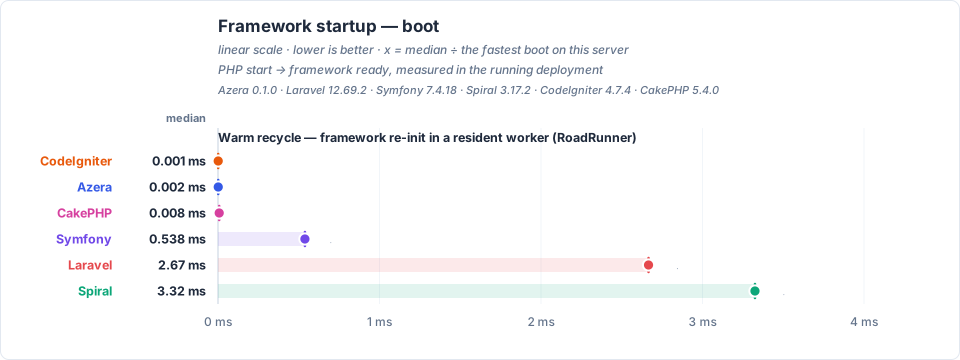
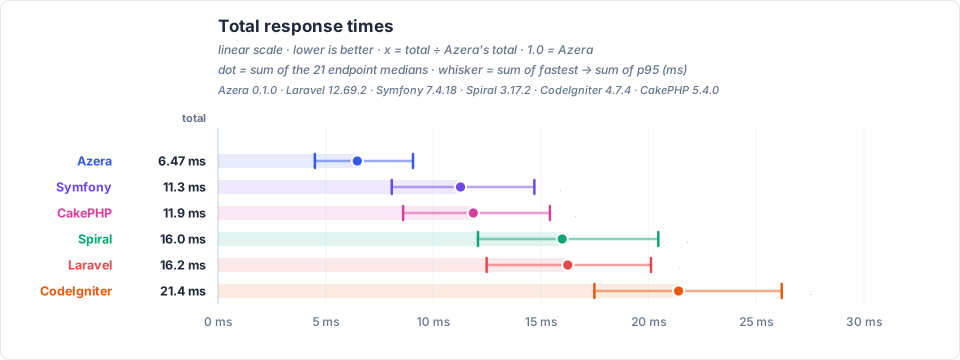
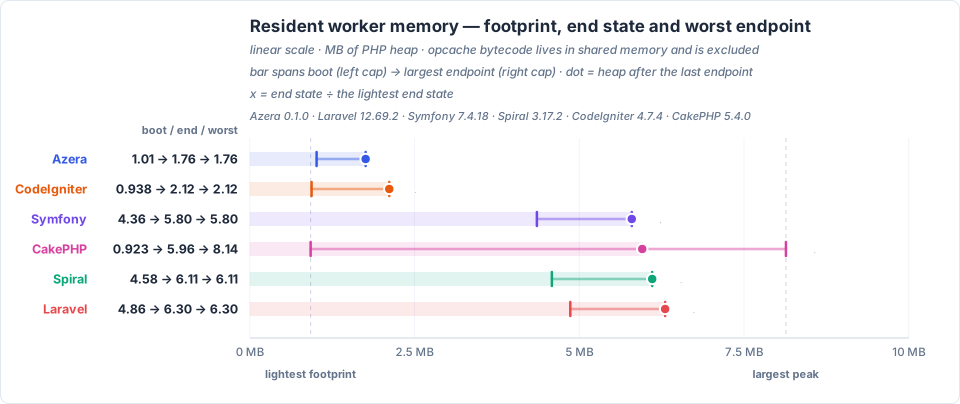
Feature benchmarks
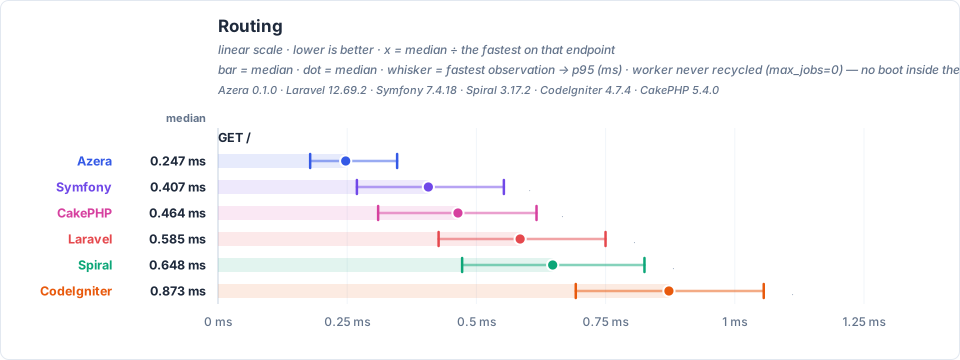
GET / — dispatches a request through the router and returns a rendered template — no database access. The `/echo` band runs the same path with a constant handler instead, so what the template render costs can be read off directly rather than inferred.
GET /items — loads one page of the 1,000 seeded rows through each framework's ORM / Active Record layer: 20 items plus a COUNT for the pagination total. The `-fast` band repeats that page with hydration switched off, so the cost of building one object per row can be read directly instead of inferred.
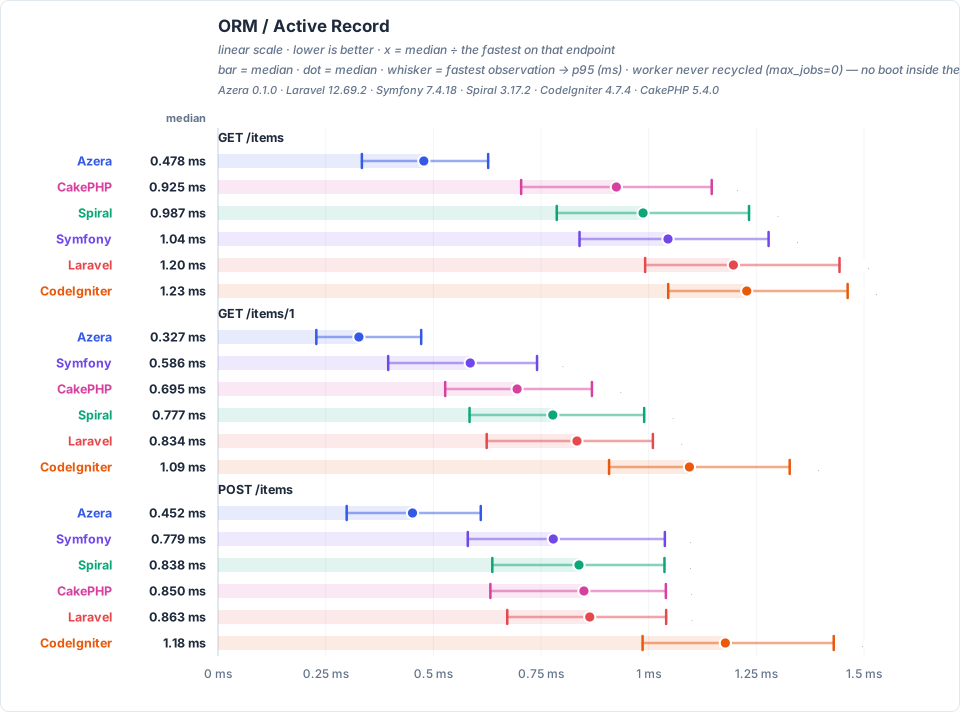
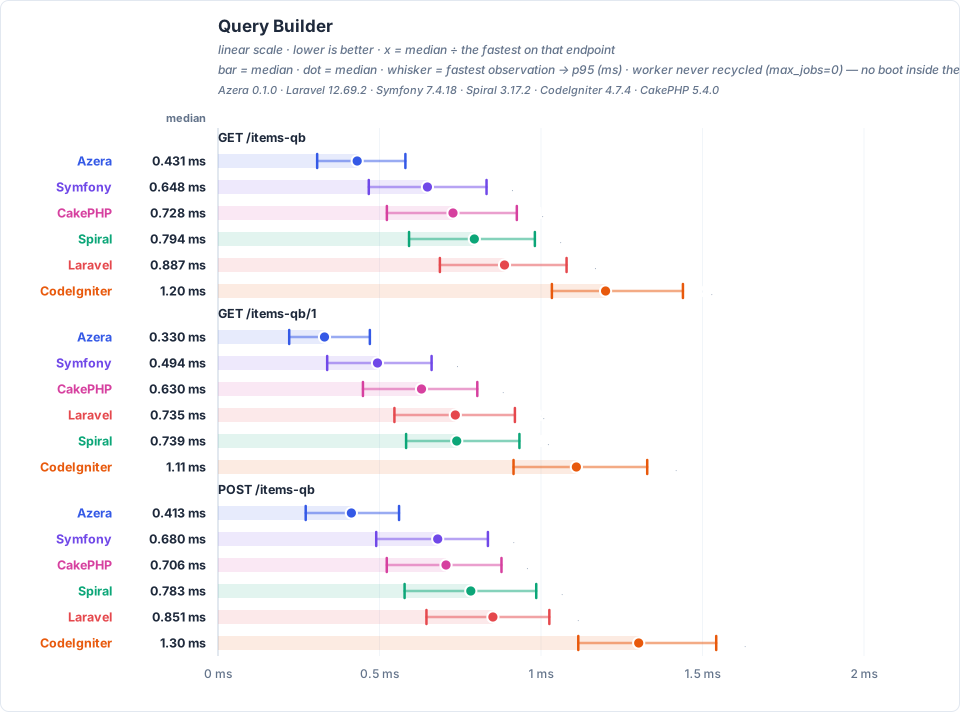
GET /items-qb — builds the same page of 20 items with each framework's query builder instead of its ORM, so the two data-access styles can be compared directly.
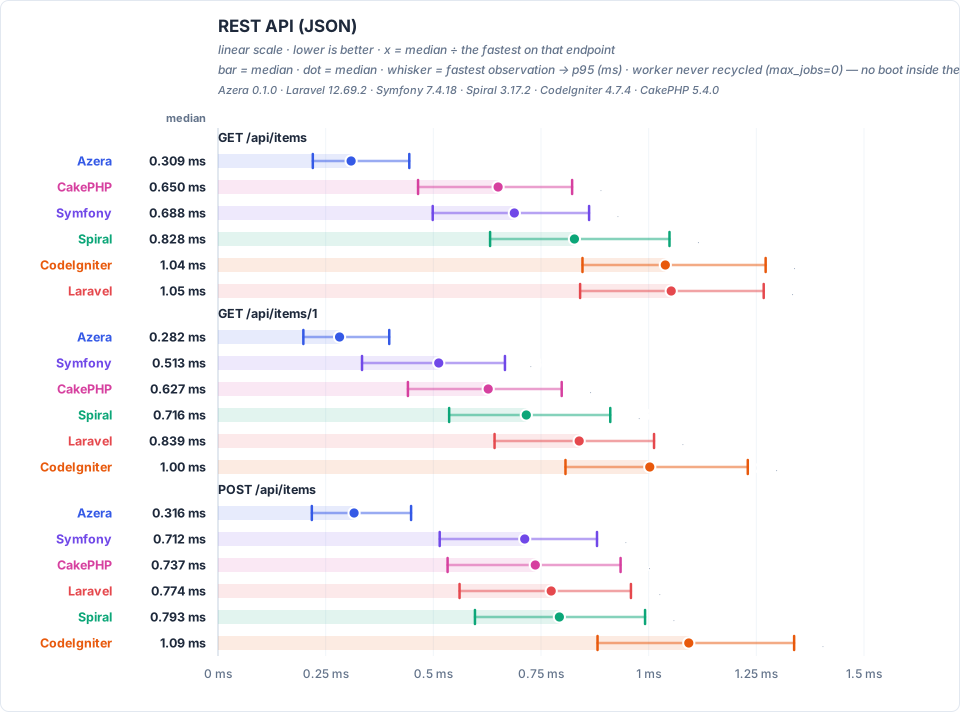
GET /api/items — serves the same page of items as a JSON response rather than HTML, which adds serialization to the ORM work. The `-fast` band repeats that response with hydration switched off, so serialization cost and hydration cost can be told apart.
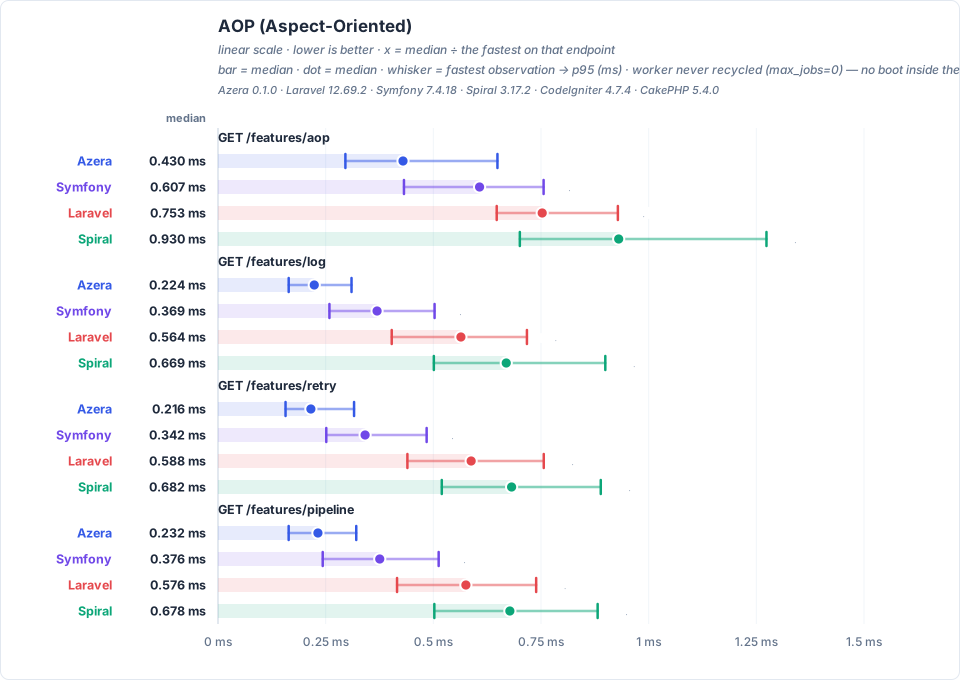
GET /features/aop — runs a request through an interceptor pipeline — logging, retry and middleware aspects wrapped around the handler. Only frameworks with an AOP layer take part.
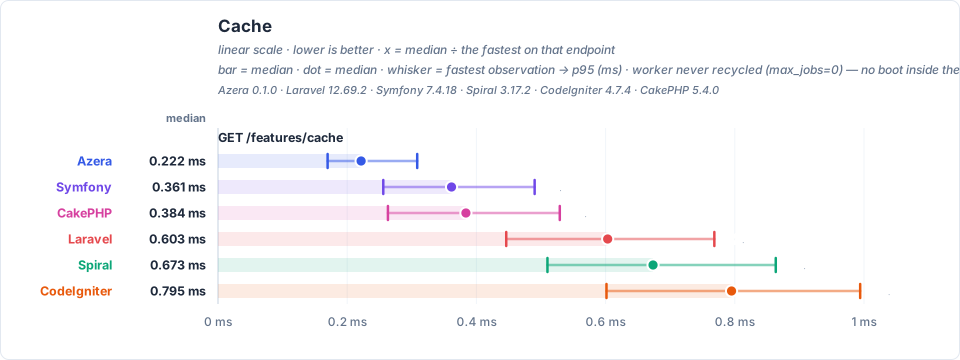
GET /features/cache — reads a COUNT(*) over the 1,000 rows through the framework's cache with a 10-second TTL, so a hit costs no database work and a miss runs the query.
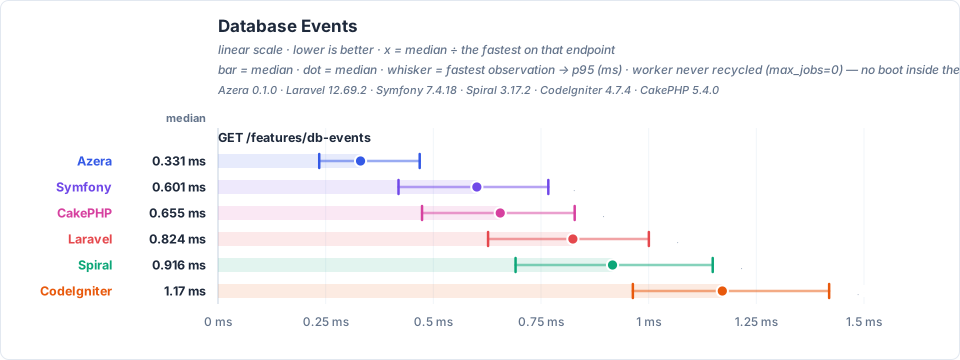
GET /features/db-events — inserts one event row per request and lets the framework's database events fire around that write.
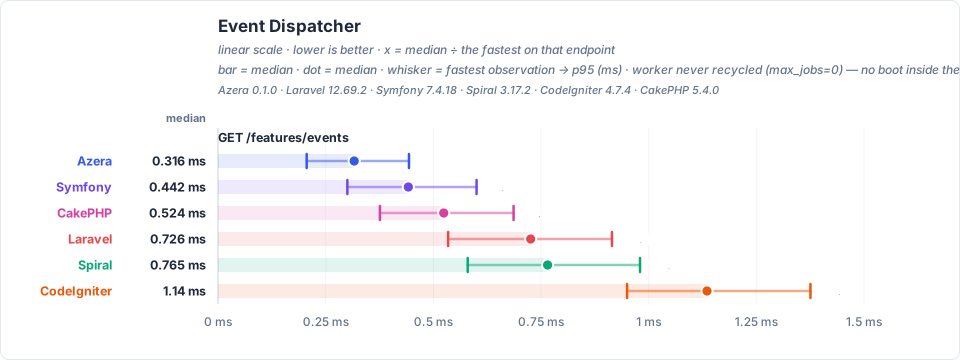
GET /features/events — dispatches an in-process event to registered listeners.
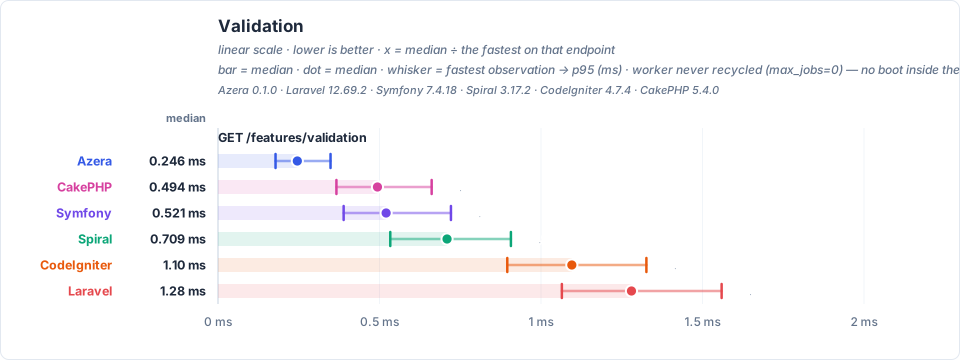
GET /features/validation — validates a payload with the framework's own validator.
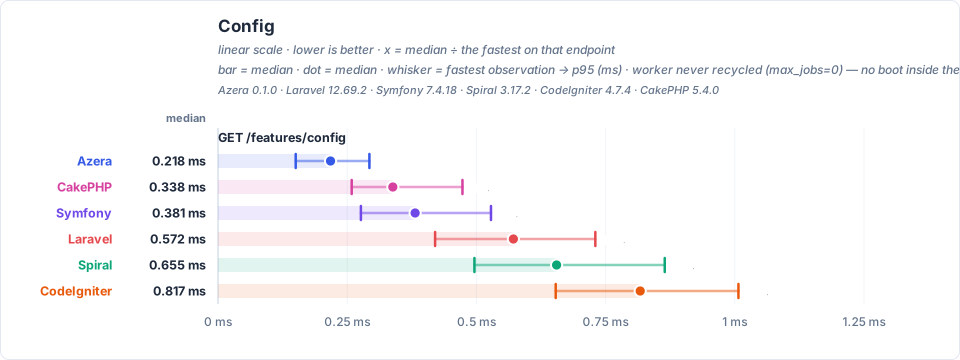
GET /features/config — resolves a value from the framework's config repository.
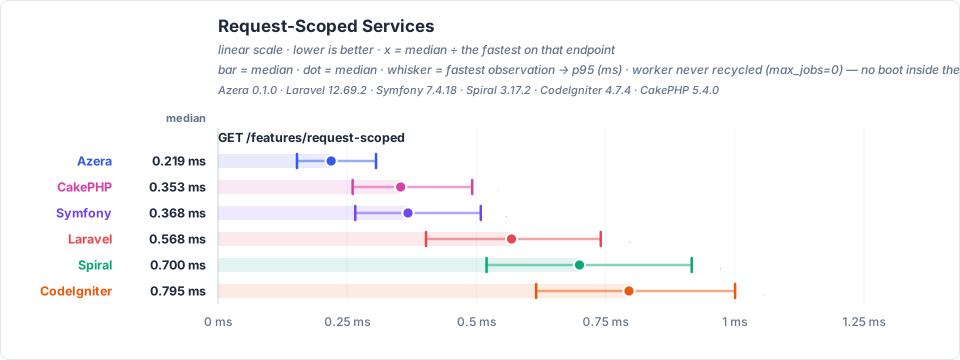
GET /features/request-scoped — resolves a service scoped to the request from the container.
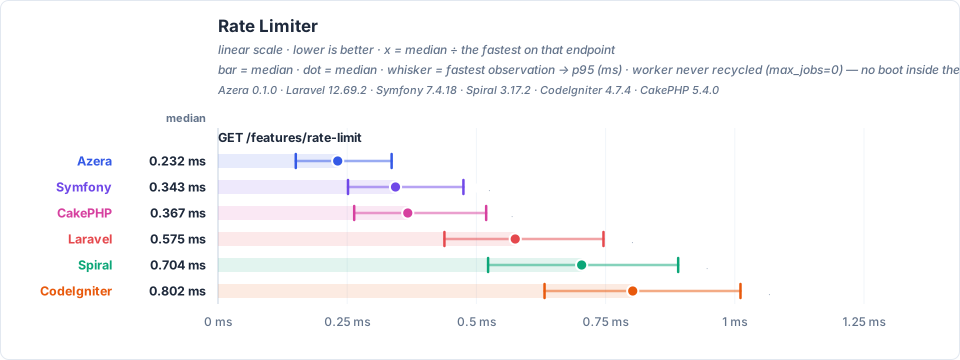
GET /features/rate-limit — checks a cache-backed rate limiter.
Latency by endpoint (ms, trimmed mean — lower is better) — the worker is never recycled (max_jobs=0), so each number is the measured request with no boot in it
| Request | Workload | Azera | Laravel | Symfony | Spiral | CodeIgniter | CakePHP |
|---|---|---|---|---|---|---|---|
GET / | no DB — routing + template only | 0.174 | 0.478 | 0.250 | 0.475 | 0.654 | 0.286 |
GET /echo | no DB — routing + dispatch only | 0.158 | 0.390 | 0.215 | 0.457 | 0.533 | 0.227 |
GET /items | 20 of 1000 items (page 1, + COUNT) | 0.297 | 1.09 | 0.803 | 0.855 | 1.09 | 0.801 |
GET /items-fast | 20 of 1000 items (page 1, + COUNT), hydrated rows not built | 0.265 | 0.804 | 0.762 | 0.787 | 1.04 | 0.692 |
GET /items/1 | 1 item by id | 0.212 | 0.729 | 0.449 | 0.643 | 0.972 | 0.571 |
POST /items | 1 row upserted (sentinel #999999) | 0.279 | 0.764 | 0.637 | 0.725 | 1.11 | 0.713 |
GET /items-qb | 20 of 1000 items (page 1, + COUNT) | 0.264 | 0.781 | 0.488 | 0.663 | 0.984 | 0.556 |
GET /items-qb/1 | 1 item by id | 0.210 | 0.637 | 0.372 | 0.596 | 0.885 | 0.485 |
POST /items-qb | 1 row upserted (sentinel #999997) | 0.252 | 0.732 | 0.546 | 0.640 | 1.14 | 0.575 |
GET /api/items | 20 of 1000 items as JSON | 0.240 | 0.874 | 0.491 | 0.742 | 0.944 | 0.483 |
GET /api/items-fast | 20 of 1000 items as JSON, rows not hydrated | 0.218 | 0.677 | 0.426 | 0.622 | 0.879 | 0.467 |
GET /api/items/1 | 1 item by id as JSON | 0.195 | 0.753 | 0.391 | 0.594 | 0.887 | 0.551 |
POST /api/items | 1 row upserted (sentinel #999998) | 0.221 | 0.749 | 0.597 | 0.681 | 0.900 | 0.689 |
GET /features/aop | no DB — interceptor pipeline | 0.313 | 0.676 | 0.458 | 0.802 | — | — |
GET /features/cache | COUNT(*) of 1000 rows, cached 10s (miss = query) | 0.167 | 0.465 | 0.229 | 0.535 | 0.692 | 0.304 |
GET /features/log | no DB — buffered log handlers | 0.168 | 0.437 | 0.226 | 0.529 | — | — |
GET /features/retry | no DB — retry policy | 0.164 | 0.456 | 0.239 | 0.541 | — | — |
GET /features/pipeline | no DB — middleware pipeline | 0.169 | 0.433 | 0.229 | 0.632 | — | — |
GET /features/db-events | 1 event row INSERTed per request | 0.227 | 0.707 | 0.475 | 0.825 | 1.04 | 0.543 |
GET /features/events | no DB — in-process listeners | 0.212 | 0.594 | 0.307 | 0.632 | 0.968 | 0.426 |
GET /features/validation | no DB — validator run | 0.175 | 1.21 | 0.416 | 0.573 | 0.976 | 0.391 |
GET /features/config | no DB — config lookup | 0.165 | 0.536 | 0.236 | 0.511 | 0.700 | 0.231 |
GET /features/request-scoped | no DB — scoped service resolve | 0.163 | 0.532 | 0.228 | 0.533 | 0.602 | 0.230 |
GET /features/rate-limit | no DB — cache-backed limiter | 0.166 | 0.569 | 0.237 | 0.543 | 0.608 | 0.243 |
Server floor — real RoadRunner over loopback: a bare resident worker that renders a fixed string (floor-rr) measures the IPC + server floor every row below also pays. Only differences larger than this floor are framework differences.