Feature benchmarks
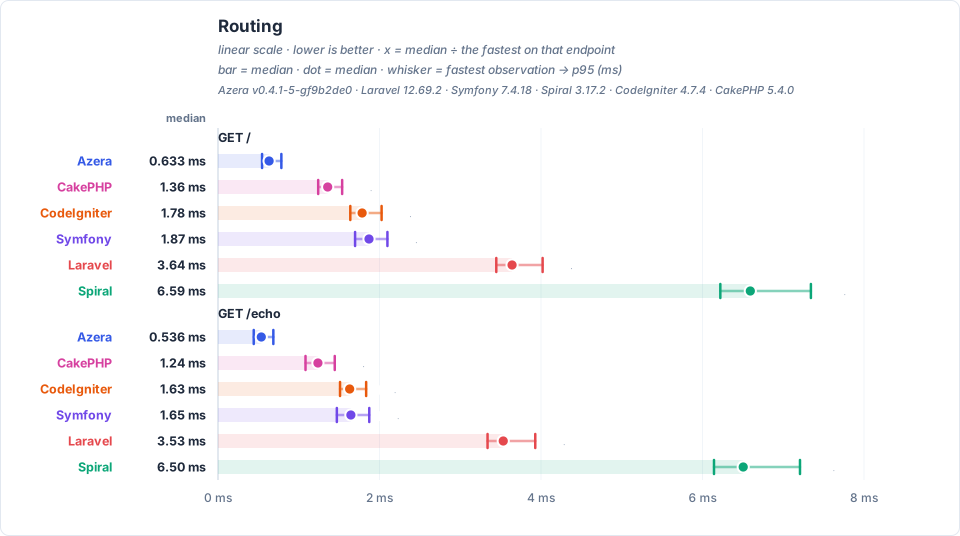
GET / — dispatches a request through the router and returns a rendered template — no database access. The `/echo` band runs the same path with a constant handler instead, so what the template render costs can be read off directly rather than inferred.
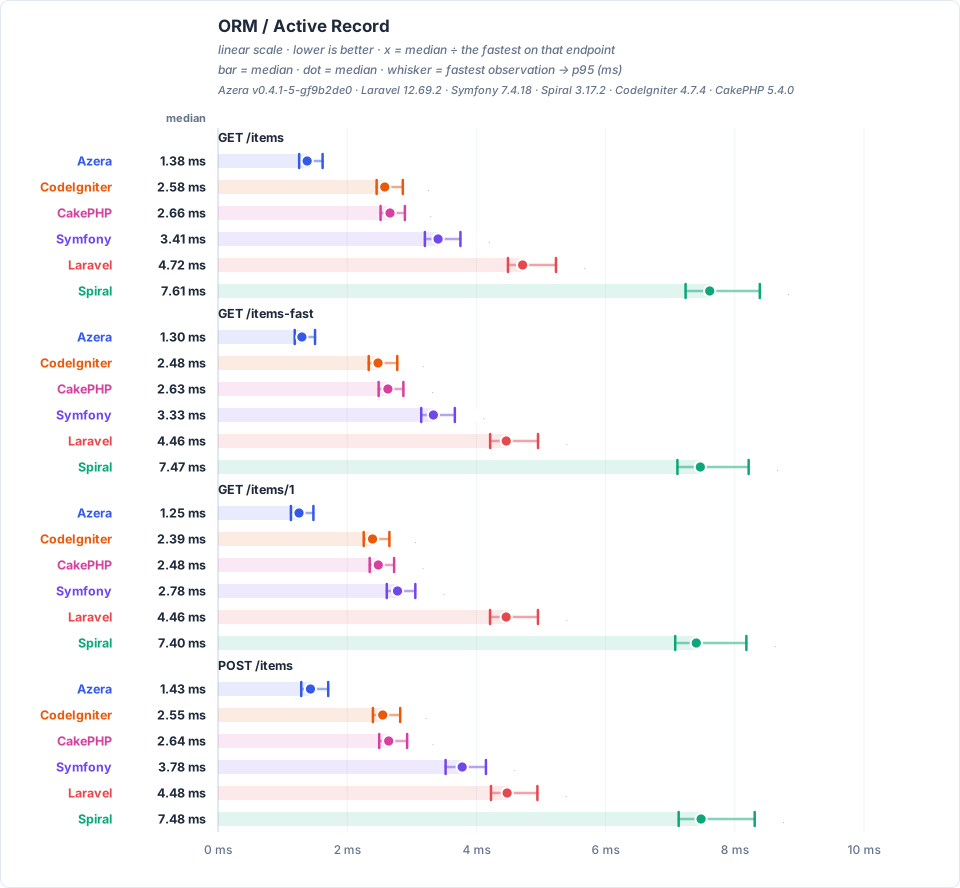
GET /items — loads one page of the 1,000 seeded rows through each framework's ORM / Active Record layer: 20 items plus a COUNT for the pagination total. The `-fast` band repeats that page with hydration switched off, so the cost of building one object per row can be read directly instead of inferred.
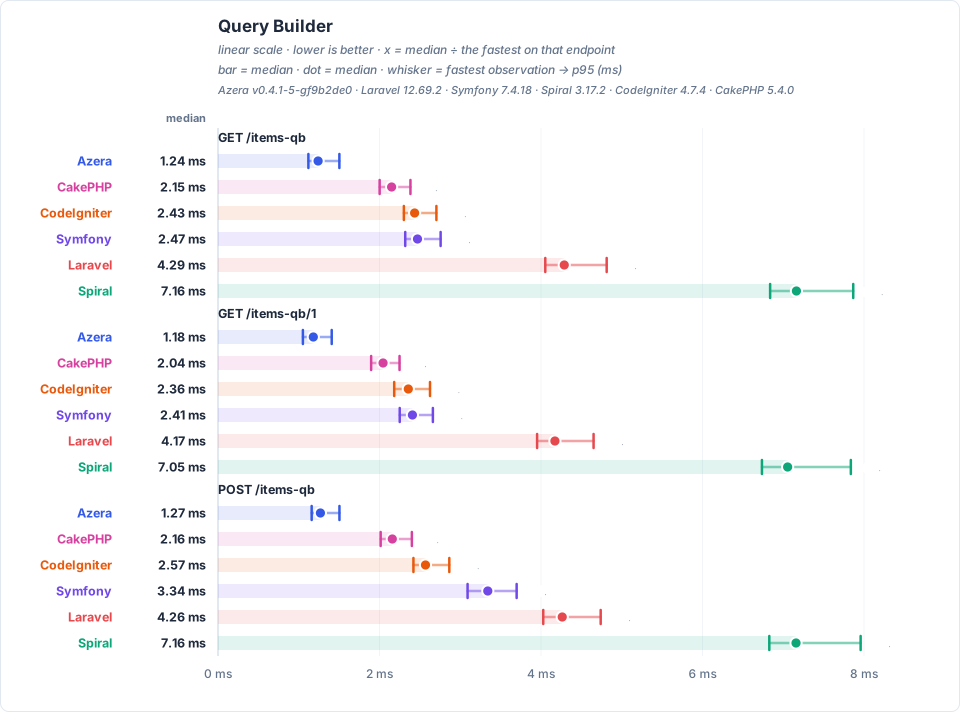
GET /items-qb — builds the same page of 20 items with each framework's query builder instead of its ORM, so the two data-access styles can be compared directly.
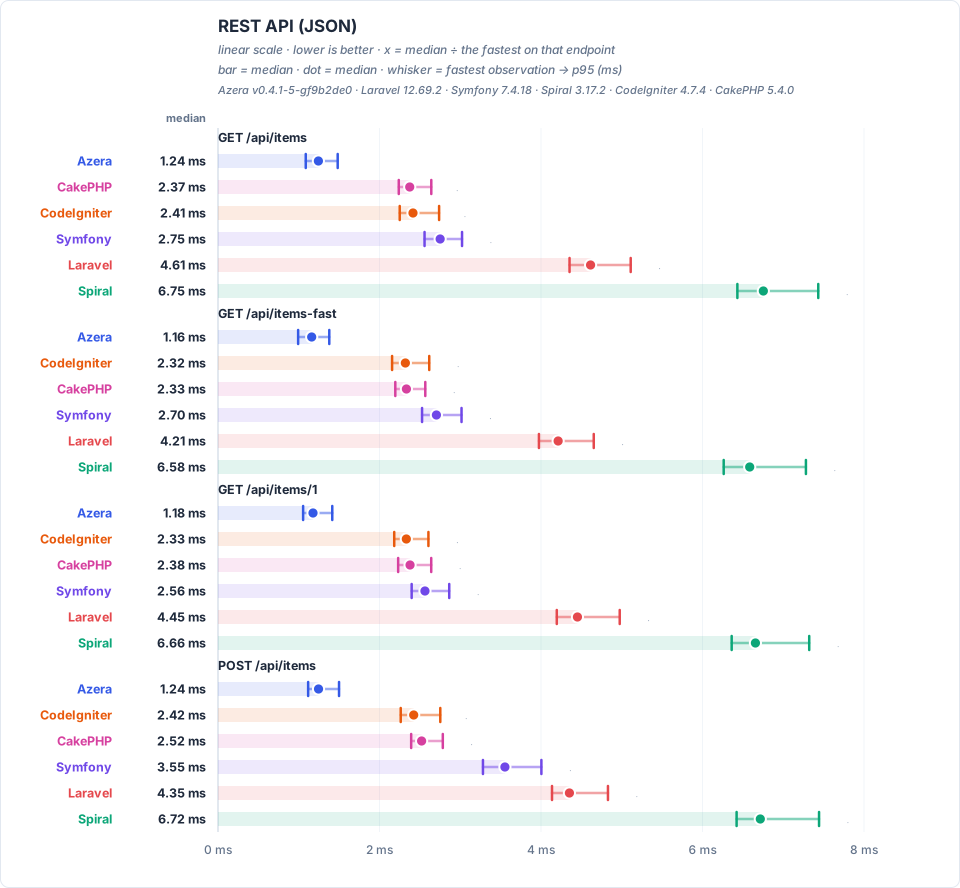
GET /api/items — serves the same page of items as a JSON response rather than HTML, which adds serialization to the ORM work. The `-fast` band repeats that response with hydration switched off, so serialization cost and hydration cost can be told apart.
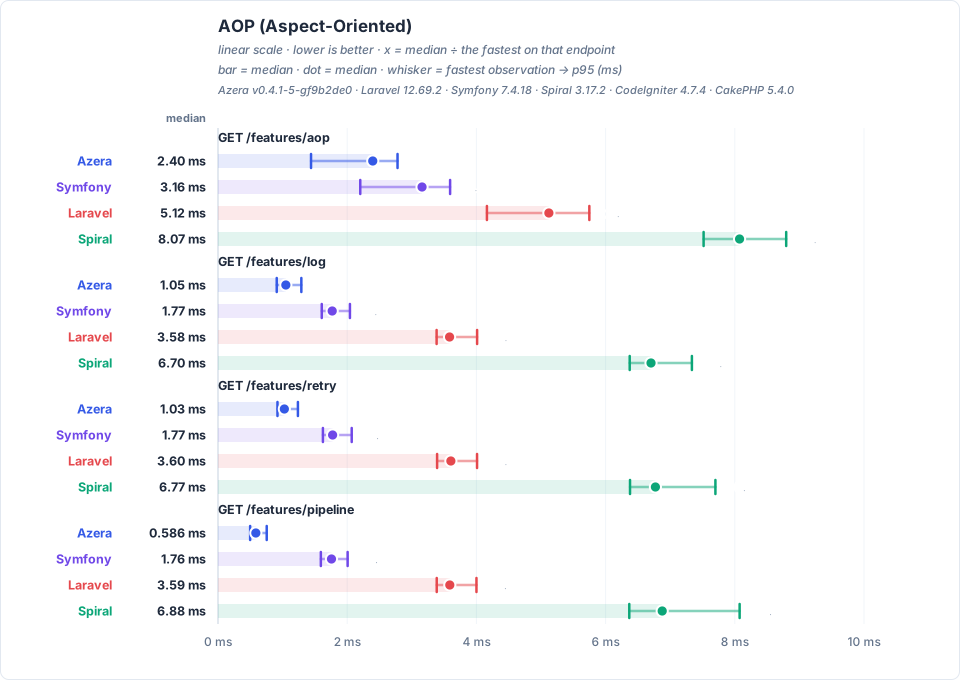
GET /features/aop — runs a request through an interceptor pipeline — logging, retry and middleware aspects wrapped around the handler. Only frameworks with an AOP layer take part.
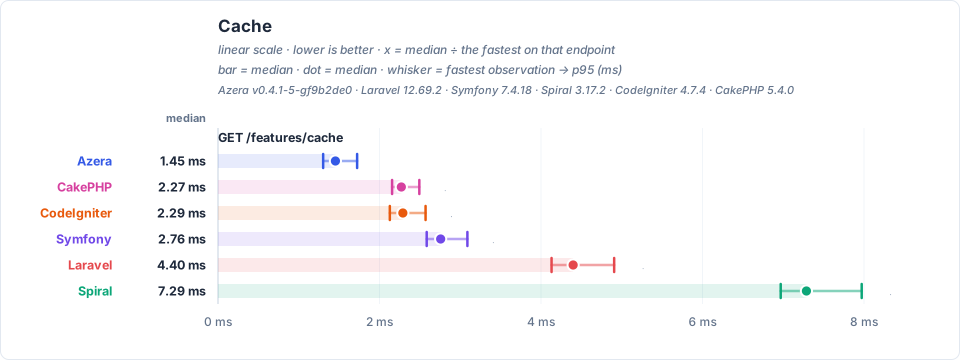
GET /features/cache — reads a COUNT(*) over the 1,000 rows through the framework's cache with a 10-second TTL, so a hit costs no database work and a miss runs the query.
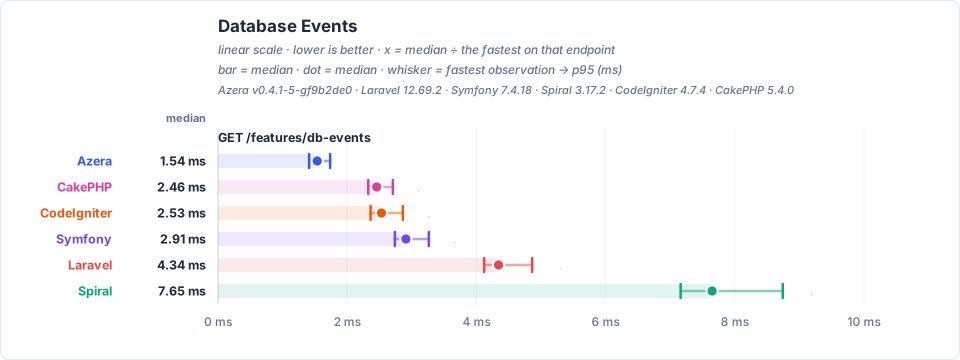
GET /features/db-events — inserts one event row per request and lets the framework's database events fire around that write.
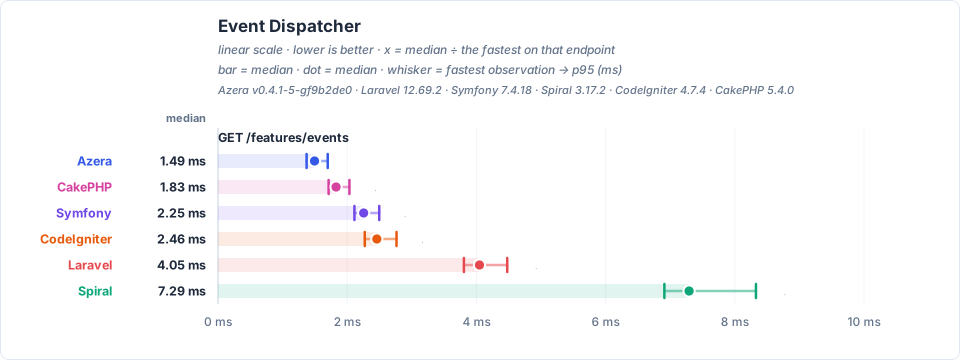
GET /features/events — dispatches an in-process event to registered listeners.
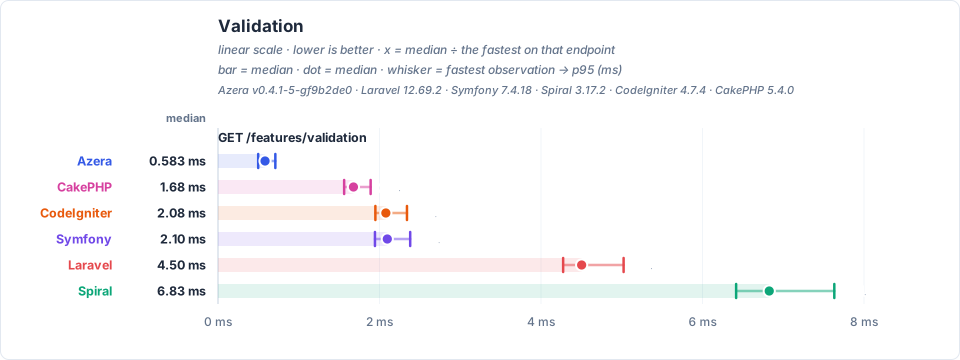
GET /features/validation — validates a payload with the framework's own validator.
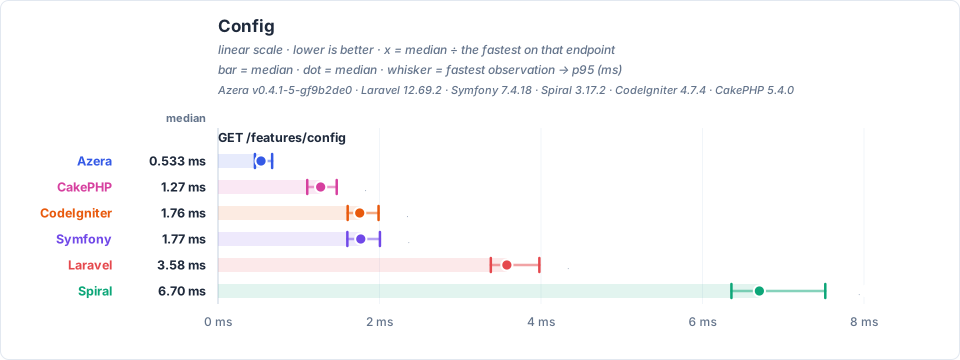
GET /features/config — resolves a value from the framework's config repository.
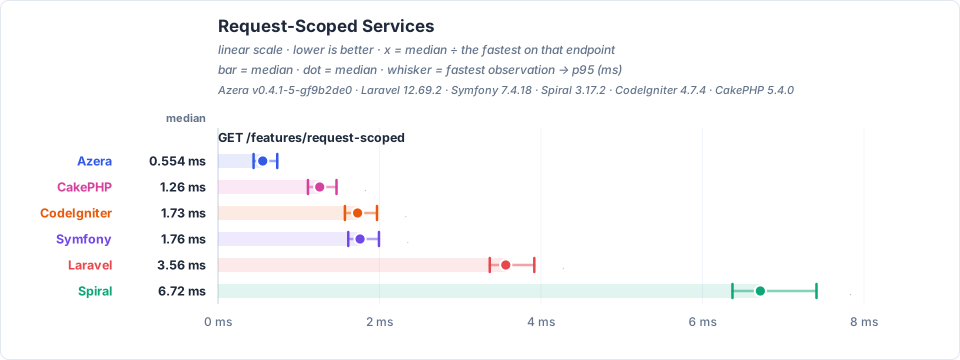
GET /features/request-scoped — resolves a service scoped to the request from the container.
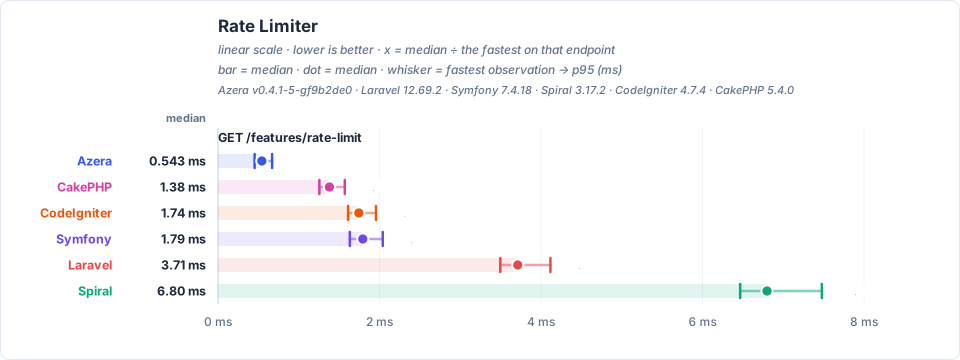
GET /features/rate-limit — checks a cache-backed rate limiter.
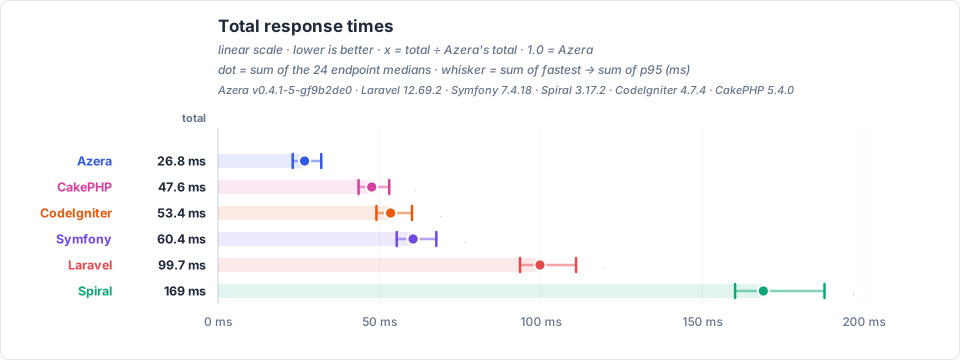
Latency by endpoint (ms, trimmed mean — lower is better)
| Request | Workload | Azera | Laravel | Symfony | Spiral | CodeIgniter | CakePHP |
|---|---|---|---|---|---|---|---|
GET / | no DB — routing + template only | 0.649 | 3.69 | 1.89 | 6.68 | 1.81 | 1.38 |
GET /echo | no DB — routing + dispatch only | 0.552 | 3.58 | 1.67 | 6.60 | 1.66 | 1.25 |
GET /items | 20 of 1000 items (page 1, + COUNT) | 1.41 | 4.79 | 3.45 | 7.72 | 2.62 | 2.69 |
GET /items-fast | 20 of 1000 items (page 1, + COUNT), hydrated rows not built | 1.32 | 4.52 | 3.38 | 7.56 | 2.51 | 2.66 |
GET /items/1 | 1 item by id | 1.28 | 4.52 | 2.81 | 7.51 | 2.42 | 2.51 |
POST /items | 1 row upserted (sentinel #999999) | 1.47 | 4.56 | 3.82 | 7.61 | 2.60 | 2.68 |
GET /items-qb | 20 of 1000 items (page 1, + COUNT) | 1.27 | 4.35 | 2.50 | 7.26 | 2.47 | 2.18 |
GET /items-qb/1 | 1 item by id | 1.20 | 4.23 | 2.44 | 7.16 | 2.39 | 2.07 |
POST /items-qb | 1 row upserted (sentinel #999997) | 1.31 | 4.33 | 3.38 | 7.29 | 2.62 | 2.20 |
GET /api/items | 20 of 1000 items as JSON | 1.27 | 4.68 | 2.79 | 6.84 | 2.46 | 2.41 |
GET /api/items-fast | 20 of 1000 items as JSON, rows not hydrated | 1.18 | 4.27 | 2.74 | 6.69 | 2.36 | 2.36 |
GET /api/items/1 | 1 item by id as JSON | 1.20 | 4.52 | 2.60 | 6.73 | 2.37 | 2.42 |
POST /api/items | 1 row upserted (sentinel #999998) | 1.27 | 4.41 | 3.61 | 6.81 | 2.47 | 2.56 |
GET /features/aop | no DB — interceptor pipeline | 2.44 | 5.19 | 3.21 | 8.16 | — | — |
GET /features/cache | COUNT(*) of 1000 rows, cached 10s (miss = query) | 1.48 | 4.46 | 2.80 | 7.38 | 2.32 | 2.30 |
GET /features/log | no DB — buffered log handlers | 1.07 | 3.64 | 1.80 | 6.78 | — | — |
GET /features/retry | no DB — retry policy | 1.05 | 3.65 | 1.81 | 6.89 | — | — |
GET /features/pipeline | no DB — middleware pipeline | 0.606 | 3.64 | 1.78 | 7.03 | — | — |
GET /features/db-events | 1 event row INSERTed per request | 1.56 | 4.41 | 2.96 | 7.81 | 2.58 | 2.50 |
GET /features/events | no DB — in-process listeners | 1.52 | 4.12 | 2.29 | 7.45 | 2.49 | 1.87 |
GET /features/validation | no DB — validator run | 0.597 | 4.57 | 2.13 | 6.93 | 2.11 | 1.70 |
GET /features/config | no DB — config lookup | 0.548 | 3.62 | 1.80 | 6.81 | 1.78 | 1.29 |
GET /features/request-scoped | no DB — scoped service resolve | 0.570 | 3.61 | 1.79 | 6.81 | 1.76 | 1.28 |
GET /features/rate-limit | no DB — cache-backed limiter | 0.558 | 3.76 | 1.82 | 6.89 | 1.77 | 1.40 |
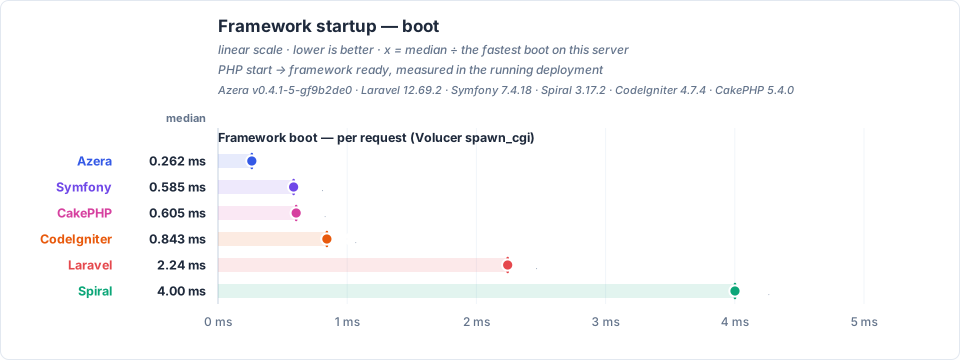
Server floor — real nginx + PHP-FPM with pm.max_requests=0: the pool never recycles its worker, so no process is spawned per request — what remains is the FastCGI handshake plus a minimal script. A hello-world endpoint that boots nothing but PHP (floor-php) and a static file through nginx (floor-http) measure exactly that cost — the floor every row stands on. Subtracting that floor leaves the framework's own per-request boot, which FPM still pays for every request even though its worker survives.